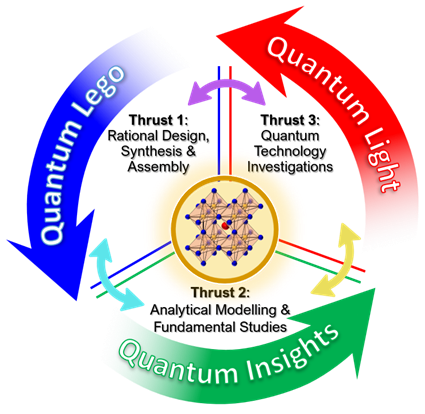
Building on the processability of metal halide perovskites, the research focuses on engineering material architectures such as quantum dots, superlattices, and heterostructures that can function as reliable quantum emitters. The research aims to identify perovskite configurations capable of producing stable, high-purity single photons, a critical requirement for practical quantum communication and sensing technologies.
This is achieved by systematically exploring how key design parameters including quantum dot size, heterostructure barrier materials, and compositional tuning through doping-influenced electronic and optical behaviour. Using the HPC capabilities of NSCC Singapore’s ASPIRE 2A supercomputer, researchers from NTU simulated a broad range of perovskite-based systems and computed their properties at scale. These simulations provided critical insights that are difficult, and in some cases impossible to obtain experimentally, helping to narrow the design space and reduce trial and error in material optimisation.
This research effort was further strengthened through close collaboration with the University of California, Berkeley (UCB), CEA Grenoble, Australian National University (ANU) and the Centre of Quantum Technologies (CQT). Their complementary interdisciplinary expertise in materials science and quantum optics, enabled direct integration of computational predictions with experimental design and characterisation.
Using NSCC Singapore’s ASPIRE 2A supercomputer, researchers modelled perovskite-based materials with DFT simulations to compute electronic and optical properties critical to quantum emitters. The simulations capture how electrons behave within the material and how their interactions give rise to light emission.
Additionally, some of the models could also incorporate spin polarisation and spin-orbit coupling to improve the accuracy for materials containing certain elements or compositions. These quantum mechanical effects strongly influence how photons are generated and emitted in perovskite materials. Accurately capturing these effects is essential for assessing emitter stability, brightness and emission purity, which are key performance criteria for quantum light sources.
Through the close integration of computational and experimental approaches, the project delivered multiple innovations, including stable, highly luminescent perovskite nanocrystals; novel multiple quantum well superlattice structures; robust, scalable single-photon sources; solid-state superfluorescence emitters; and perovskite quantum emitters with potential applications in quantum communications, sensing, and metrology.
The resulting published findings establish new benchmarks for perovskite quantum emitter performance, providing the research community with validated reference points for comparison, design, and optimisation, and offering critical insights that help guide future materials development for next-generation quantum technologies.
These works include:
The DFT calculations in this project were performed using supercomputing resources provided by NSCC Singapore’s ASPIRE 2A system, which enabled both computational efficiency and advanced materials modelling at scale. Its HPC capabilities supported the research in the following ways:
- Massive parallelisation and high core counts: ASPIRE 2A supports scaling to up to 128 CPU cores per node, enabling dozens of perovskite property calculations to be run simultaneously. This reduced total simulation walltime from several weeks to just a few days, enabling rapid exploration of multiple material configurations.
- Large-memory node configurations: Access to nodes with up to 512 GB of RAM enabled the modelling of large perovskite supercells and computationally demanding DFT calculations. This was particularly important for simulations incorporating spin polarisation and spin–orbit coupling, which require substantial memory and would otherwise be constrained on conventional systems.
- GPU acceleration potential: ASPIRE 2A provides GPU nodes that can accelerate computationally intensive workloads, such as hybrid functional calculations and optical property simulations.This capability supports further performance gains for advanced electronic structure calculations as modelling complexity increases.
The development of a new family of scalable, high-fidelity, bright, on-demand, and stable perovskite single- and multi-photon sources, together with solid-state superfluorescence emitters, positions this research as a key enabler for quantum information science and technology. By addressing long-standing challenges around emitter stability, reproducibility, and scalability, the project advances the practical viability of perovskite-based quantum light sources.
The knowledge generated and proof-of-concept demonstrators developed through this work contribute directly to progress in quantum communications and quantum networking, where reliable single-photon generation underpins secure information transfer. In doing so, the research establishes improved performance benchmarks and measurement sensitivities for quantum photonic systems, providing the wider research community with reference points that can inform future device design, system integration, and standardisation efforts.
Beyond scientific impact, the project has the potential to deliver longer-term societal and economic benefits by enabling more secure and resilient technologies across multiple sectors. Potential applications span national security, through advanced sensing and secure communications; transport, where robust sensing and information exchange are increasingly important; and banking and finance, where quantum-secure networks can strengthen data protection in the face of evolving cyber threats.
Over the past three years, the project has focused on establishing the fundamental material science and device-level performance of stable, high-performance perovskite quantum emitters for optical quantum applications. Current efforts are directed towards integrating these emitters into functional optical quantum devices with clear commercialisation potential. Looking further ahead, the availability of stable, scalable, and on-demand perovskite quantum emitters is expected to support broader adoption of quantum technologies across industries, helping to translate advances in quantum materials into societal and economic impact.
“Designing quantum light sources that can reliably emit single or multiple photons is a complex challenge that requires detailed computational studies of the structure-function relationships of materials. With support from NSCC Singapore’s high performance computing resources, our team can carry out analyses at a scale that would otherwise be impractical, enabling a more systematic exploration and refinement of perovskite-based emitters. This computational capability is a key enabler for advancing more efficient, reliable, and scalable quantum light sources for future quantum networks and ultra-secure communication systems.”

Sum Tze Chien
Director, Institute of Advanced Studies, Nanyang Technological University (NTU), Singapore
Associate Dean (Research), College of Science, NTU, Singapore
Professor, Division of Physics & Applied Physics, School of Physical & Mathematical Sciences, NTU, Singapore