1 Fusionopolis Way,
Connexis South, #17-01,
Singapore 138632
© National Supercomputing Centre (NSCC) Singapore. Updated as of 14 May 2024.
NSCC Singapore strives for products and services with the highest levels of security and reliability.
Supporting Singapore’s Student Teams at the SC25 Student Cluster Competition
NSCC Singapore’s Support for National University of Singapore (NUS) and Nanyang Technological University (NTU) at SC25
The Student Cluster Competition (SCC) is one of the most demanding undergraduate challenges in high performance computing (HPC), testing teams on their ability to design, deploy and optimise a computing cluster under strict time, power and performance constraints. At Supercomputing Conference 2025 (SC25) in St. Louis, Singapore was represented by Team Kent Ridge from NUS and Team Supernova, from NTU.
By enabling the teams’ in-person participation, NSCC Singapore helped provide students with hands-on exposure that extended far beyond technical theory. From infrastructure setup and cabling to hardware configuration, tuning and logistics, students gained first-hand experience working with real systems. Being on site also allowed the teams to engage directly with industry leaders, hardware vendors and the global HPC community—an experience difficult to replicate remotely.
NUS: Building Systems-Level Capability Through First In-Person SCC Participation
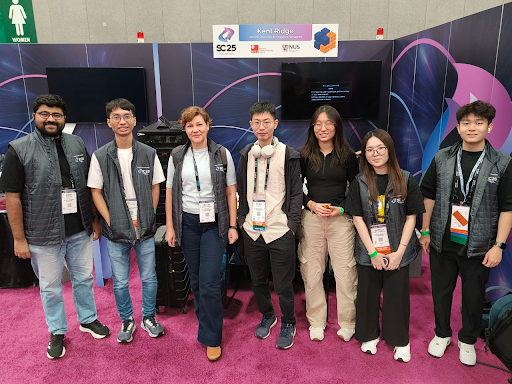
Team Kent Ridge (TKR) at SC25
Competing as Team Kent Ridge (TKR), the NUS team drew students from the CS3210 Parallel Computing course and was led by Dr Cristina Carbunaru and Dr Sriram Sami. SC25 marked NUS’s in-person debut at the Student Cluster Competition, making the team’s ability to independently build and deploy a working cluster—and compete on the global stage—a significant milestone for the team. Team Kent Ridge was first introduced to HPC through early engagement with NSCC Singapore, including ASPIRE 2A data centre tours, introductory workshops and the annual HPC Users Symposium.
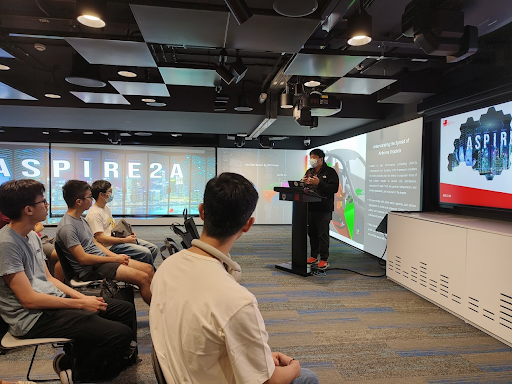
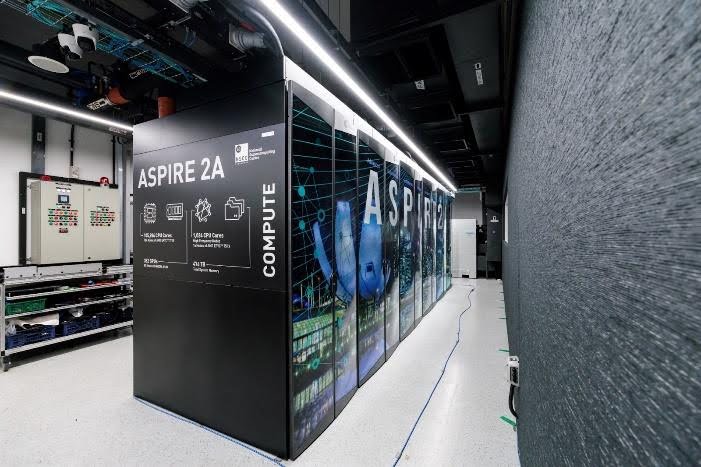
CS3210 students (including SC25 team members) at a tour of NSCC Singapore’s ASPIRE 2A and ASPIRE 2A+ data centre
Preparations for the competition spanned several months, with weekly meetings focused on application deep-dives, progress reviews and technical discussions. Timed mock runs were conducted to simulate competition conditions, and subject-matter experts within the university were consulted where needed to refine system configuration and optimisation strategies.
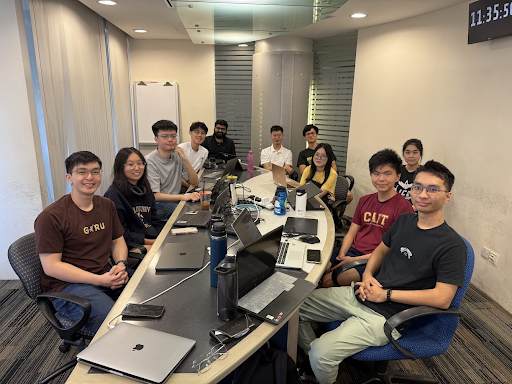
Full TKR team meetings
A key milestone was achieved even before the competition began. Despite limited prior experience with physical cluster deployment—and without vendor involvement—the students successfully built a working cluster from scratch within a week. This required rapid troubleshooting across networking, BIOS settings, compilers and system integration, reinforcing the importance of systems-level understanding alongside application performance.
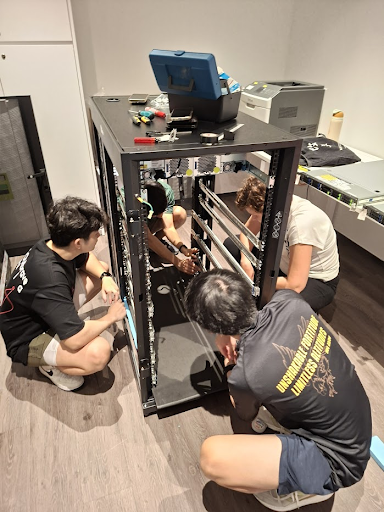
Rack Preparation for Shipping
The team credited this achievement to their strong collective spirit, with members drawing on complementary strengths to support one another, an approach that proved equally critical during the competition itself. Reflecting on the experience, team leader Way Yan shared:
“HPC is not always a glamorous job. Much of the work involves building applications and troubleshooting rather than optimisation. However, this process is character-building, and the debugging mindset developed carries over into many other areas.”
Beyond the competition itself, the team’s innovative solution to the MLPerf challenge during the SC25 SCC contributed back to the broader HPC community. The team developed a custom hybrid parallelism approach that combined different ways of distributing the workload across nodes to overcome limitations arising from the incompatibility between their system’s multi-node configuration and the existing MLPerf setup. This enabled the benchmark to run efficiently while avoiding memory limitations. The team subsequently shared these insights with the broader MLPerf community.
NTU: Sustaining a Strong Undergraduate HPC Pipeline
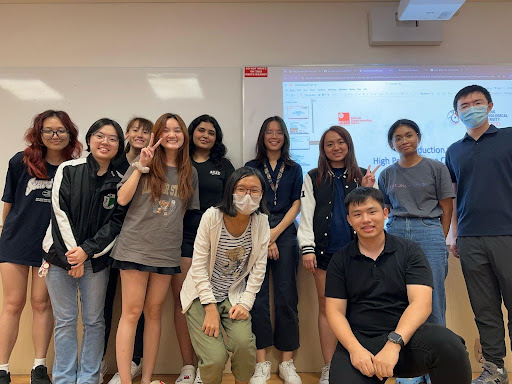
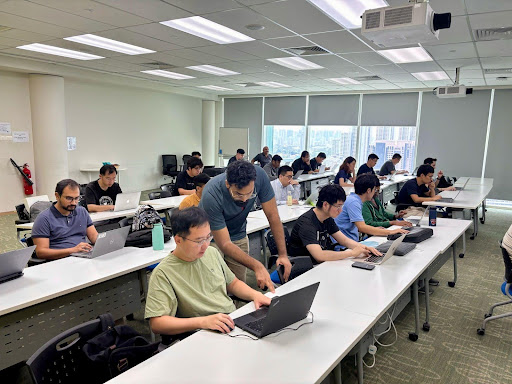
NTU HPC team hosting an Introduction to ASPIRE 2A workshop for NTU students
NTU’s participation in SCC this year builds on a long-standing tradition of engagement in international SCCs, dating back to ASC14, where the team achieved a Silver Award. This legacy drives NTU’s mission to cultivate HPC awareness and capability among undergraduates. This year, Team Supernova was guided by their advisor, Dr Loke Yuan Ren and Dr Wang Chen.
In the months leading up to the competition, students underwent structured training in Linux system administration, cluster deployment, scheduler configuration and performance optimisation for both scientific and AI workloads. Their preparation included extensive benchmarking using HPL and MLPerf under strict power constraints, alongside mock competition runs and focused debugging sessions. Knowledge transfer from previous cohorts played an important role in accelerating the team’s readiness.
This effort was supported by close collaboration with NSCC Singapore for compute resources, and industry partners for hardware guidance. Advisors and senior students played a key role in preparing the team for the high-pressure SCC environment.
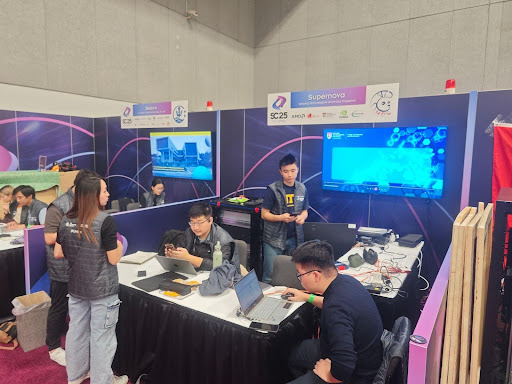
Supernova at SC25
For the students, the experience was both technically and personally significant. Team member Tan Yoong Ken reflected:
“I’m incredibly grateful to NTU and NSCC Singapore for the opportunity to compete on a global stage. Working alongside teammates who turned challenges into learning experiences made this one of the highlights of my university journey.”
Insights gained from SC25 will inform NTU’s long-term HPC education strategy, with lessons integrated into teaching materials, lab sessions and co-curricular workshops. NTU will also continue preparing future SCC teams, strengthening a sustainable pipeline of HPC-skilled graduates for research, national priorities and the global supercomputing community.
Beyond competition preparation, NTU strengthened its HPC outreach and education efforts in 2025. The HPC student club organised two undergraduate workshops introducing core HPC concepts, cluster usage and parallel programming, attracting students from across engineering and computing disciplines. NTU also launched a new undergraduate parallel computing course, providing structured training in MPI, OpenMP, GPU programming and performance engineering, and translating competition-driven insights into the formal curriculum.
Developing Singapore’s Future HPC Talent
Held annually at the Supercomputing conference, the SCC challenges students to demonstrate end-to-end HPC expertise—from system assembly and application porting to performance optimisation under real-world constraints. These experiences help develop not only technical depth, but also resilience, collaboration and problem-solving skills essential for modern HPC environments.
By supporting the participation of NUS and NTU teams at SC25, NSCC Singapore continues to invest in the development of Singapore’s future HPC talent—connecting students with real systems, real challenges and a global community.
View more highlights from NSCC Singapore’s participation at SC25 here.