The research aims to make high-fidelity simulations of ammonia and hydrogen combustion more practical on modern supercomputers. These simulations are computationally intensive, requiring researchers to resolve intricate turbulent flame and detonation structures while tracking complex chemical reactions. As supercomputing architectures increasingly shift towards GPU acceleration, many established reacting-flow codes, originally developed for CPUs, need to be adapted or replaced. However, the performance and optimal configurations of newer GPU-enabled solvers for realistic combustion problems remain relatively unexplored. This project set out to answer those questions systematically on NSCC ‘s hardware.
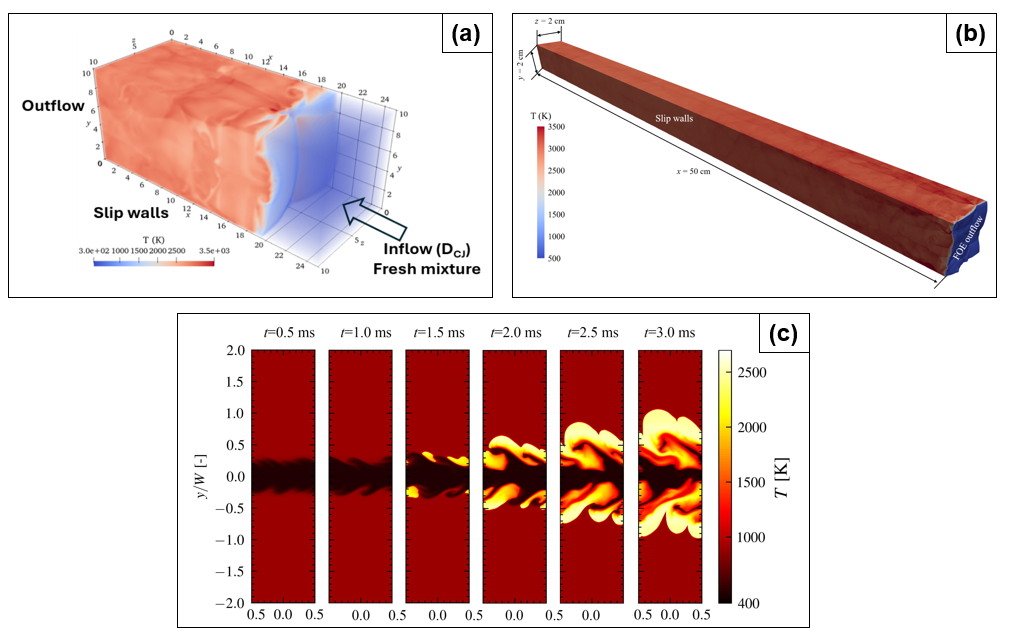
One area of focus was ammonia ignition in blends of ammonia and dimethyl ether under engine-like conditions at a pressure of 60 bar. To better understand how ignition develops, the team carried out direct numerical simulations that resolved every scale of the turbulent flow while tracking 48 chemical species involved in 294 chemical reactions.
The simulations showed that ignition first occurred within the shear layer and was driven by the high reactivity of dimethyl ether. Acting as an ignition promoter, dimethyl ether helped initiate the combustion of ammonia, which is otherwise difficult to ignite.
The second application concerns hydrogen detonation. Unlike ordinary combustion, a detonation involves a supersonic combustion wave that can generate extremely high pressures. The front of a detonation is not smooth but is broken into a honeycomb of cells created by interacting shock waves. The size of these cells determines whether a detonation can be sustained in a given space and how far its damage extends, which makes cell structure central to hydrogen safety assessment. The team simulated hydrogen detonations in two and three dimensions, including a three-dimensional case with 245 million computational cells, together with an oblique detonation formed when a detonation wave interacts with a solid wedge.
With the computational power of NSCC’s ASPIRE 2A and ASPIRE 2B supercomputers, the team was able to perform the large-scale simulations required to investigate ammonia ignition and hydrogen detonation. Central to this work was the use of gpuFoam, a GPU extension of OpenFOAM, and PeleC, a reacting-flow solver built on the AMReX adaptive mesh refinement framework. Together with technical support from NSCC, these tools enabled the researchers to harness GPU-accelerated computing for complex reacting-flow simulations.
At the centre of the project is a direct comparison between two fundamentally different ways of moving a reacting-flow simulation onto GPUs.
gpuFoam takes an incremental approach, retaining the familiar OpenFOAM framework running on CPUs and transferring only the most computationally demanding component, the stiff chemical kinetics, onto the GPU. PeleC, on the other hand, takes a different approach. Built on the AMReX framework and designed for GPU computing from the outset, it keeps the entire calculation on the GPU. By evaluating both approaches, the team sought to understand their respective performance and suitability for complex combustion simulations.
The team also explored ways to improve computational efficiency. Chemical calculations in reacting-flow simulations are often distributed unevenly across the domain. To address this, the team first redistributed the chemical problems evenly across all CPU processes before having each process submit its batch to the GPU through NVIDIA’s Multi-Process Service, which allows 16 processes to feed a single GPU simultaneously.
The computational capabilities built during the project are already generating supporting research, including studies of how detonation waves interact with vortices and how trifluoroiodomethane, a candidate agent for suppressing hydrogen explosions, can inhibit hydrogen detonations.
These results have been presented at international conferences in 2026, including the 25th World Hydrogen Energy Conference in Singapore and the 41st International Symposium on Combustion in Japan.
NSCC’s supercomputers played a critical role in enabling the large-scale simulations required for the project. The production simulations used up to 256 CPU cores with 16 A100 GPUs on ASPIRE 2A, and up to 128 H200 GPUs on ASPIRE 2B.
With HPC support, the team was able to leverage:
- High-performance GPU computing: Delivered the performance equivalent of approximately 80 to 200 CPU cores per GPU, depending on the solver and hardware used
- Simulation at scale: Enabled large-scale ammonia ignition and hydrogen detonation simulations with high levels of chemical detail, supporting more comprehensive investigations of complex combustion phenomena.
- Accelerated research workflows: More than halved the time required for the ammonia ignition study by moving chemical kinetics calculations onto GPUs
- Massively parallel computation: Completed a three-dimensional hydrogen detonation simulation comprising 245 million computational cells in under 10 hours on 128 GPUs
- Hardware evaluation and optimisation: Supported benchmarking of multiple GPU generations on identical workloads
- Accelerated runtime Runtime for a 21-million-cell case on four GPUs, fell from 9.86 hours on A100 GPUs (ASPIRE 2A) to 3.13 hours on H200 GPUs (ASPIRE 2B), a speedup of approximately 3.15 times.
Beyond providing advanced computing resources, the project also highlighted the importance of optimising applications to make effective use of GPU-accelerated systems. The team documented and shared its technical findings with NSCC, contributing knowledge that could support other researchers in improving the performance of their computational workloads.
As hydrogen and ammonia emerge as potential alternatives to fossil fuels, understanding their combustion behaviour is essential to supporting their safe and effective adoption.
The project has advanced understanding of ammonia ignition under engine-like conditions, showing how dimethyl ether promotes ignition in ammonia–dimethyl ether blends. These findings provide a scientific basis for further investigations of ignition control and combustion strategies for ammonia-based fuels, with potential applications in marine propulsion and power generation.
For hydrogen, the computational capabilities developed through the project are also supporting research into detonation–vortex interactions and the potential of trifluoroiodomethane (CF₃I) to suppress hydrogen detonations. These studies could inform future hydrogen hazard assessments and explosion mitigation strategies particularly for hydrogen storage and transport systems.
In the long term, these advances could support the development of more reliable ammonia combustion technologies and safer hydrogen systems.
“The benchmarks demonstrate that NSCC’s GPU cluster delivers exceptional computational performance and scalability for exascale-class simulations, significantly outperforming conventional CPU-based systems. This capability enables high-fidelity, three-dimensional modelling of complex hydrogen combustion phenomena, accelerating research into safer and more efficient low-carbon energy technologies.” (Dr. Zifeng Weng)
“Direct numerical simulation with detailed chemistry remains slow and costly on conventional computing resources. NSCC’s GPU resources have greatly accelerated our research, and this capability underpins our work on cleaner ammonia combustion.” (Dr. Yicun Wang)
“NSCC’s GPU resources have enabled us to perform large-scale combustion simulations more efficiently and investigate complex processes in greater detail. These capabilities strengthen our research into hydrogen safety and ammonia combustion, providing a scientific foundation for cleaner and safer energy technologies.” (Dr. Hao Yan)

Dr Zifeng Weng, Dr Yicun Wang, and Dr Hao Yan
Department of Mechanical Engineering
National University of Singapore